
A week off (kinda)
Some online readings to kindle curiosity


I don’t think I’ve missed a week here in the years I’ve been writing these meditations, and I don’t intend to start now.
Still, it was a week of unexpected business things, unexpected personal things, also unexpected dental surgery, and my meditative powers escaped me.
However, I read as much as usual and bounced around the web, and I found a bunch of things compelling. So, today, forgive me, while you’re enjoying your morning tea/coffee on this holiday weekend (for Americans), I’m going to point you in other directions, and next week I’ll return to form.
From the week:
Articles
“Brooklyn urban spelunking mystery - what did I find?,” Ask Metafilter
An urban spelunker asks for help figuring out what they found underground in Brooklyn.
Many years ago, my friend lived in the garden/ground level apartment at 150 Columbia Heights, right up against the Brooklyn Promenade in Brooklyn Heights.
The door to enter her apartment shared a small vestibule with a different door that we assumed was just used for maintenance. Being the weirdo I am, I saw it was unlocked and encouraged my friends to check it out with me. It opened into another small room, with another unlocked door. I opened that door and it let to a very narrow, very steep stairway that led very far down. I was hyped. Our small group decided that it would be a great idea to go down those stairs to see what else would be down there. Was it wise? Prob not. Was it a great idea after a few glasses of wine and a lifetime of horror movie tropes? Definitely.
“Hanoi’s humble beer glass and the memory of a nation,” by Parni Ray, The Sunday Long Read
Recounting the origin story of Vietnam’s handmade glass for serving beer.
Every few weeks, HABECO trucks pull up to the Xôi Trì workshops to collect hundreds of beer glasses, packed by the dozen in straw and bundled into tightly wrapped plastic gunny bags. The embossed H at the base of each cốc is more than branding, it marks the glass’s enduring tether to the company. HABECO remains the workshop’s primary client, sustaining a relationship that has tied the city’s beer culture to its small-scale manufacturers for decades.
“A Little Deeper Than Usual: Joan Didion on The Grateful Dead,” by Joan Didion, POW
A dip into Didion’s archives finds her initial impressions of Garcia and co.
“You can take pictures, but Pigpen’s not here. Pigpen is easily our most photogenic member.”
“You know even his mother calls him that now. His mother calls up and asks for Pigpen.”
“He smiles a lot –– he’s really a pixie.”
“We could start a Pigpen comic book, something along the lines of Gasoline Alley.”
“Or a Pigpen and Laird comic strip –– called ‘Bickering In the Basement.’”
“Our managers are perfect examples of hippies that are making good –– they’re sort of part time students at San Fransisco State. They just decided to manage us. They didn’t know anything about managing, of course, nothing at all, but they got into it tooth and nail, learned what games are played, super–great.”
“Empire Loves a Dark Sky” by Mohamad Naleh, Places Journal
Why darkness is a military asset.
Agrarian life, like that still practiced in southern Lebanon, requires careful attention to the ledger of the sky, whose patterns register most clearly at night. 2 Mastery of these nocturnal readings promises a steadier harvest and, by extension, a more secure future. The moon enacts its own language: its phases, its clarity or lack thereof, the halo that sometimes gathers around it — each a signal of rain or its absence. Constellations rise and recede in cycles that guide the timing of irrigation and harvest. Thunder carries meaning in its duration; a long rolling sound signals harsher conditions, a sharp one suggests milder weather. Lightning along known ridgelines indicates whether a storm is nearing or passing, guiding decisions about the safety of livestock. Even distant phenomena, comets and shooting stars, are deciphered according to the directions of their movement, each pointing toward fortune or calamity. The skills required to read the sky in this way are an inheritance shaped by necessity, a means of seeing and hearing the seasons before they arrive.
“The Men Who Want Women to Be Quiet,” by Helen Lewis, The Atlantic
What’s holding together American conservatives? Reportedly a “masculinism” that is currently approaching “its imperial-overreach phase.”
Masculinism is now approaching its imperial-overreach phase, like the Roman empire that many of its leaders so admire. For some of its most ardent adherents, if someone on the left is doing anything, regardless of their sex, it’s feminized and bad. Meanwhile, when Trump sends out a bitchy Truth Social post about a petty grievance, that is a display of manly vigor. Tucker Carlson’s perfectly buoyant coiffure? Rugged—butch, even. Ben Shapiro’s heartwarming enjoyment of musical theater? In the best tradition of the Vikings or Spartans, probably. This reductive view of the world—women things bad, men things good—is the mirror image of the worst excesses of 2010s Tumblr feminism, when introverted teenage girls posted hashtags like #KillAllMen and drank from mugs that read MALE TEARS.
“Do You Dream?” by Nick Cave, The Red Hand Files
Nick Cave details how he sleeps.
I go to bed around midnight, but before I have time for any blue glow, dwelling on fragments of memory, or lyrical musings, I put on a podcast, which keeps intrusive late-night thinking at bay. This podcast generally amounts to one person who doesn’t know what they’re talking about, talking to another person who doesn’t know what they’re talking about, about something I know absolutely nothing about, and this triumvirate of stupidity generally lulls me into some approximation of sleep (the first sleep). I wake three hours later. I get up and go downstairs, where I read something soothing for half an hour or so – at the moment, The Owl – a Biography, The House at Pooh Corner or The Art of Bible Translation. Then I go back to bed, podcast-free, for another three hours (the second sleep).
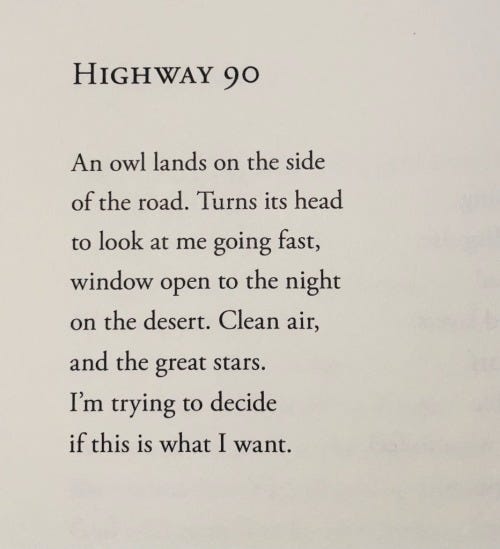
And the poem “Highway 90” by Linda Gregg, from All of It Singing: New and Collected Poems, via Headlights Forever
And some new-to-me weird things:
A website finds empty movie screenings near where you live.
Recipes for mixing bottled waters to recreate the water profiles of cities known for coffee, tea, baking, and more.
A hand-cranked machine types “I hope this email finds you well.”
𓀠 Tomorrow’s 3+ things for members:
As an experienced home cook, the only chef-y things I consider essential to own and use
An Italian chef’s recipe for zucchini carbonara
A new, affordable addition to the skincare regimen
Join the community for just $6/month and enjoy the Sunday supplements: great books, travel/fashion picks, new music and cool stuff generally.
❀ Hey, if you’re a writer looking for help—editing, coaching, brainstorm juju—I recommend collaborating with Rachel Knowles.
Rachel has helped me significantly over the years, not to mention lots of other writers: novelists, screenwriters, Substack-ers, the gamut. Whether you’re aspiring or established, everyone needs an editor. More info at her website.
What the what
“Meditations in an Emergency” is a weekly essay from author Rosecrans Baldwin about something beautiful. Paying subscribers receive a Sunday supplement with three-plus things to love, plus a monthly travel-lust ballyhoo.
Rosecrans is a correspondent for GQ, a contributor at Travel + Leisure, and the bestselling author of Everything Now, winner of the California Book Award. Other books include The Last Kid Left and Paris, I Love You but You’re Bringing Me Down. His debut novel, You Lost Me There, was a New York Times Book Review Editors’ Choice.
For magazine articles, bio, contact info: rosecransbaldwin.com.
Disclaimer: if you buy something using a link from here, I may receive a commission.