
In flight
What happens at nearly a thousand miles an hour

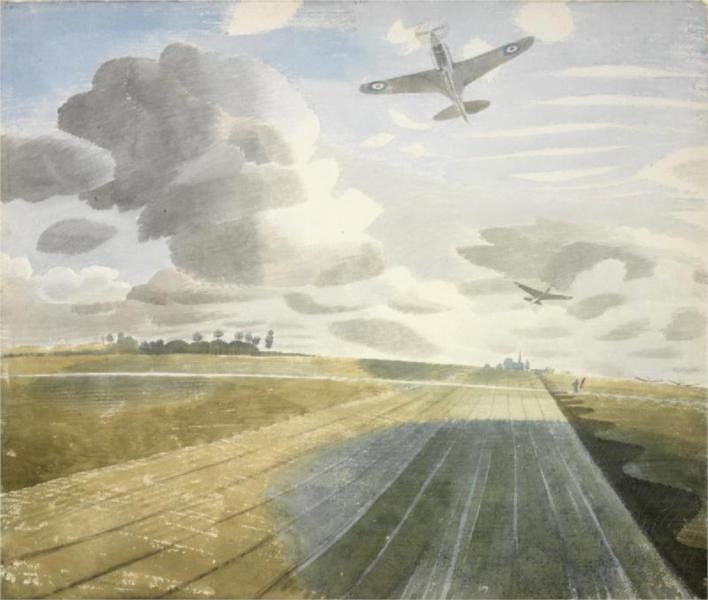
Wednesday morning, I took an airplane to New York City.
I hadn’t been on a long flight in a while. For the last three years I’ve gone to an airport at least once a month, this time the experience felt renewed. First off, people are different on a plane. Human rhythms are different. Time feels different, there’s a feeling about time that’s less persistent.
And there’s something intimate in the experience without the appearance of being so, aside from the ways our bodies touch, brushing each other in the aisle. The cabin is both immense and small, a tunnel of chairs. It’s like traveling via train or bus, but there’s no sense of motion with the windows shaded. Going forward, never backward, and yet a flight can feel like a back door from life.
Or a communion with oneself, amidst a couple hundred people also communing.
(Or maybe not: one woman across the aisle, a row head of me, spent most of the flight texting with ChatGPT.)
Regarding time, I wondered at one point what the young man sitting next to me would think. He was one of the last to board. Early twenties with poofy hair, in a black leather jacket, carrying the biggest Starbucks cup. No bag, no books, no magazines. Instead, he tuned the seat-back monitor to a map of our trip, with a clock at the top counting down the minutes remaining—and for four and a half hours he looked at little else, except occasionally to glance at the email inbox on his Android.
What was he thinking? What was he feeling? Occasionally he’d swipe his inbox to refresh, though he didn’t have Wifi, he seemed to be swiping unconsciously.
I thought at another point, maybe a flight attempts to allow a person to return to just being. Sit, breathe, eat, sleep. You’re free to move about the cabin—sure, but how free, and how free do we really want to be? And how little tolerance there is on a flight for change, how deterministic a flight must be, how stable the world inside the plane seems compared to the world outside it.
Weird thoughts appear at 35,000 feet—is it the altitude, or is it just me? Things like…
is it a coincidence that the end of social voicemails, social phone calls, came about with the rise of podcasts?
do babies perceive bubbles as enclosed air?
Halfway through the flight, above the middle of the country, my neighbor finished his Starbucks and requested coffee, black with cream, though he asked the attendant to pour it straight into his Venti cup. And around that time, I wrote down, “it is possible on a flight to feel an expansion of mind.”
Also: “I forgot how tasty Cheese-Its.”
I was rereading On Breathing by Jamieson Webster on the plane, in preparation for an interview, and this phrase stood out to me: “somatic vicissitudes.” I underlined it because I didn’t know what it meant. At that point, there was an hour left in the flight and my neighbor had finished his coffee, he was attempting to sleep on his traytable with his poofy hair around his head resembling a small, curled-up dog. Had the somatic vicissitudes gotten to him? Was the timer no longer tolerable? Lately, talking to friends, it sounds like there’s an emotional plague on the land. Things feel adrift, formulas seem broken; the psycho-political deformations are perverse, and yet the stock market soars. I know one person who has a group chat with colleagues where there’s no texting, just pictures of nice things from nature (to cheer them up). Yet I also know people doing incredible, inspiring things: adopting and/or fostering children, making art, organizing political groups, all the physical human movements that bypass complaint, that sneak around social media and AI. The atmospheric conditions of this moment, the “plane” we’re all traveling in, seem to allow for it all.
The flight finished and I headed for the subway. I would take a bunch of subway trains over the next few days, and almost all the ads I saw in the train cars were for AI. And the one I saw most that wasn’t for AI software promoted a book instead, a hardcover titled If Anyone Builds It, Everyone Dies: Why Superhuman AI Would Kill Us All.
Each time I saw it, I thought, is this what it was like to live during the development of nuclear weapons? And I also thought occasionally about my seat-mate, the kid with floppy hair, and wondered what larger timers we’re not paying attention to.
𓀠 Tomorrow’s 3+ things for members:
Speaking of AI, a recent experiment I conducted with Claude that had startling, enjoyable results
My favorite tote bag for a six-day trip, and other bags I’ve got an eye on
Short fiction to try if you (like me) read very little short fiction
Join the community for just $6/month and enjoy the Sunday supplements: great books, travel/fashion picks, new music and cool stuff generally.
❀ Hey, if you’re a writer looking for help—editing, coaching, brainstorm juju—I recommend collaborating with Rachel Knowles.
Rachel has helped me significantly over the years, not to mention lots of other writers: novelists, screenwriters, Substack-ers, the gamut. Whether you’re aspiring or established, everyone needs an editor. More info at her website.
What the what
“Meditations in an Emergency” is a weekly essay from author Rosecrans Baldwin about something beautiful. Paying subscribers receive a Sunday supplement with three-plus things to love, plus a monthly travel-lust ballyhoo.
Rosecrans is a correspondent for GQ, a contributor at Travel + Leisure, and the bestselling author of Everything Now, winner of the California Book Award. Other books include The Last Kid Left and Paris, I Love You but You’re Bringing Me Down. His debut novel, You Lost Me There, was a New York Times Book Review Editors’ Choice.
For magazine articles, bio, contact info: rosecransbaldwin.com.
Disclaimer: if you buy something using a link from here, I may receive a commission.